
Wednesday Mornings, 5th of August, 10AM -12:30PM
3 Christine Street, Constantia, Cape Town
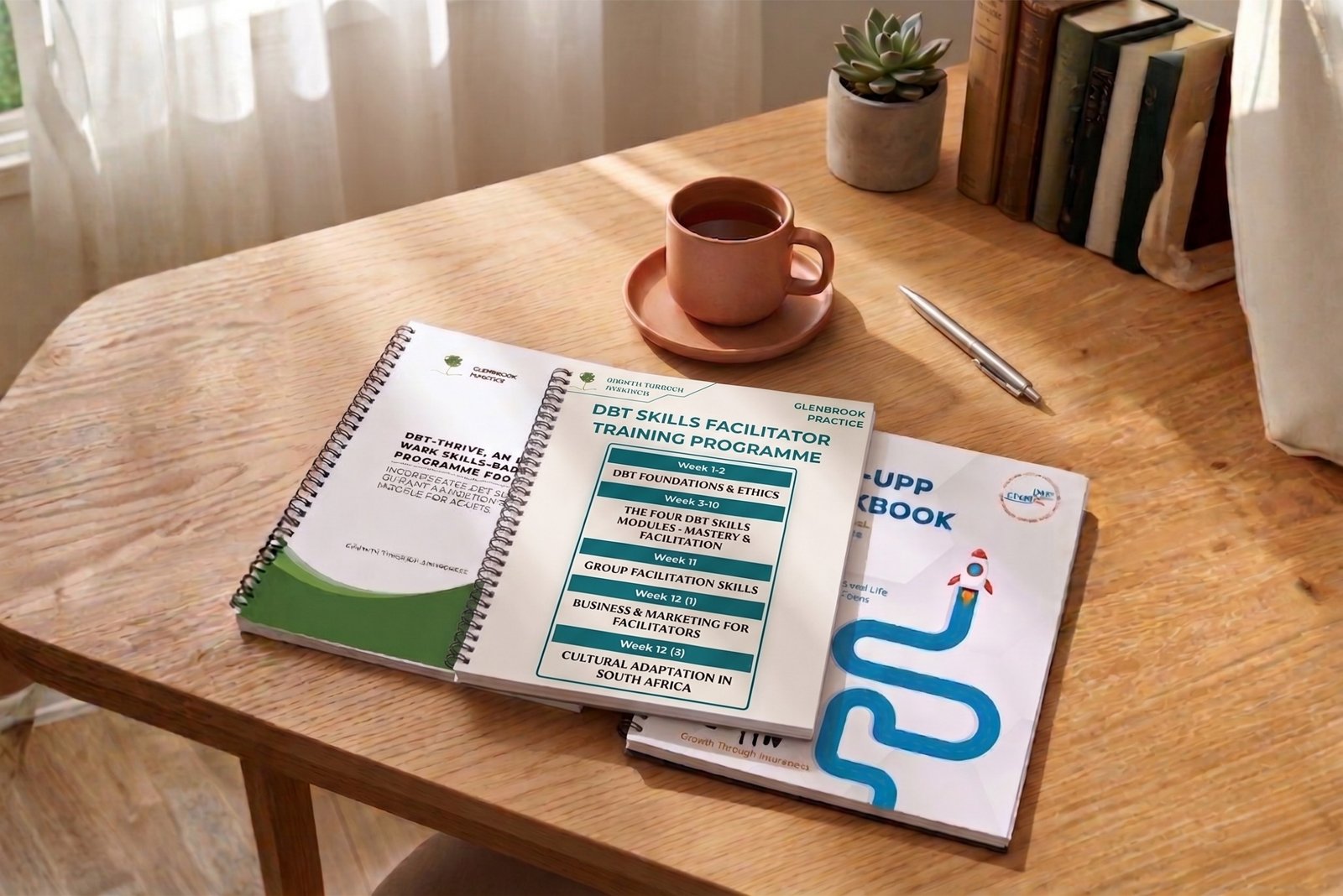
dbt skills facilitator training programme
Bridge the gap between Academics and practice

Find out how we are strengthening Glenbrook Practice with the latest DBT Skills Training
Introduction by Jonathan Mitchell
As a seasoned DBT skills instructor with over twenty years of dedicated experience, I have witnessed firsthand the transformative power of these practical tools in countless individuals’ lives. I received my foundational training in DBT-informed skills at the Kenilworth Clinic Adolescent Unit (KAYA), where I was introduced to Dr Marsha Linehan’s principles and guidelines, which continue to shape all my programmes and private practice work today.
Having begun my journey by facilitating DBT groups and family therapy in that adolescent unit, I
established Glenbrook Practice in 2015 with a clear mission rooted in our guiding philosophy, Growth Through Awareness. Through programmes such as the 8-week DBT-THRIVE for adults and the 12-week DBT-STEP-UPP for teens, along with Dr Marsha Linehan’s evidence-based DBT principles, I have helped clients build emotional resilience, navigate relational challenges, and lead more balanced lives.
Yet I have also observed a persistent gap: many talented Honours psychology graduates complete their degrees only to face barriers to further study or clinical placement, leaving them unable to apply their knowledge in meaningful practice. Similarly, occupational therapists, counsellors, psychologists, and other professionals frequently seek accessible, high-quality training to expand their toolkit with evidence-based skills.
This 12-week DBT Skills Facilitator Training Programme is my direct response to that need. It offers an experiential pathway for you to master the adult DBT-THRIVE curriculum as well as the 12-week DBT-STEP-UPP programme for teens yourself, ensuring you fully understand how the skills operate from the inside, before learning to deliver them confidently to your own clients and groups.
Whether you are transitioning from academic training to real-world application or enhancing an
established professional practice, this programme equips you with clinical competence, ready to use resources, facilitation expertise, and business foundations to begin providing impactful support. invite you to join me in expanding the reach of these proven tools across South Africa.
— Jonathan Mitchell

Jonathan Mitchell
Jonathan Mitchell | BA (HSS) (Psych) (UNISA) | Executive Officer & Director of DBT Operations, Programmes and Publications | Glenbrook Practice & Dialectical Consulting Services (Pty) Ltd. (Reg No: 2015/308832/07)
Programme Overview

Glenbrook Practice is pleased to introduce a new 12-week in-person DBT Skills Facilitator Training Programme designed specifically for recent Honours psychology graduates and allied professionals. Delivered exclusively in Cape Town’s Southern Suburbs, the programme presents our established adult DBT-THRIVE curriculum and our 12-week DBT-STEP-UPP teen programme at a measured pace. Participants experience the four core DBT skills modules as learners (using materials from both adult and teen programmes) before acquiring the expertise to facilitate them independently for clients of all ages.
No prior DBT experience is required. The training combines deep personal skill acquisition with professional development in group facilitation, ethical practice, and sustainable business setup. By the conclusion, you will be prepared to offer standalone skills-based coaching or structured groups to both adult and teenage clients experiencing emotional dysregulation, anxiety, depression, impulsivity, or interpersonal difficulties.
Programme Structure & Curriculum
The curriculum is structured across five integrated core modules, delivered progressively over 12 weeks. Each session is 2.5 hours and incorporates didactic teaching, experiential practice, supervised facilitation exercises, and reflective discussion. You will learn to deliver the four foundational DBT modules using both the adult DBT-THRIVE format and the age appropriate adaptations in the 12-week DBT-STEP-UPP teen programme.
DBT Foundations & Ethics
Comprehensive orientation to Dialectical Behaviour Therapy: its theoretical basis, scope of practice, ethical boundaries, referral protocols, and integration with non-psychologist roles. Includes orientation to both adult and teen programme structures.
The Four DBT Skills Modules – Mastery and Facilitation
Participants engage directly with the adult DBT-THRIVE and teen DBT-STEP-UPP content (Mindfulness, Distress Tolerance, Emotion Regulation, and Interpersonal Effectiveness) as learners, using Glenbrook Press materials. You will then learn structured facilitation techniques, including session planning, homework integration, and adaptive teaching methods for both adults and adolescents, and how to integrate these skills on an individual basis for a client. This training will enable you to deliver one-on-one DBT skills training effectively in individual client sessions and in groups.
Group Facilitation Skills
Practical strategies for creating safe, engaging, trauma-informed groups; managing group dynamics; adapting content for varied ages (adults vs teens); and incorporating mindfulness openers and diary-card reviews.
Business & Marketing for Facilitators
Guidance on establishing independent practice: pricing models, contracts, professional insurance, corporate wellness packages, and targeted marketing via WhatsApp, Instagram, and LinkedIn.
Cultural Adaptation in South Africa
Localised application of DBT skills, with examples relevant to South Africa’s diverse communities, language considerations, and socio-economic contexts, including working with both adult and teenage clients.
What You Will Gain from the Programme
This accessible, high-quality training requires no prior DBT experience. You will be equipped to support both adults and teens experiencing overwhelming emotional states, anxiety, depression, shame, anger outbursts, impulsive behaviours, or interpersonal conflict.
Through hands-on practice, you will learn to teach clear, practical strategies so clients can:
- Observe and regulate emotions without escalation
- Tolerate distress in the moment
- Communicate assertively and hold healthy boundaries
- Stay present even in chaos
Expert-led by Jonathan Mitchell, the programme includes:
- Ready-to-use session plans and participant materials from Glenbrook Press for both the adult DBT-THRIVE and teen DBT-STEP-UPP programmes
- Practical guidance on one on one coaching, group facilitation, and private practice (with age specific adaptations)
- Pricing and business setup tips to help you start earning immediately.
Walk away with real clinical confidence, a stronger CV, and the ability to offer meaningful standalone skills support to adults and teens, all while building your professional portfolio and income stream.